ERP Tutorial 12 — The VERIDEX Decision Workbench: Ten Dimensions, One Score
Every tutorial in this series has been, without saying so, a tour of inputs. Sales orders created demand. Inventory held the stock answer. BOMs and routings defined feasibility. Capacity set the limits; suppliers set the risks; master data held it all together. This final tutorial visits the page where all of it converges into a single number: the VERIDEX Decision Workbench.
The Engine
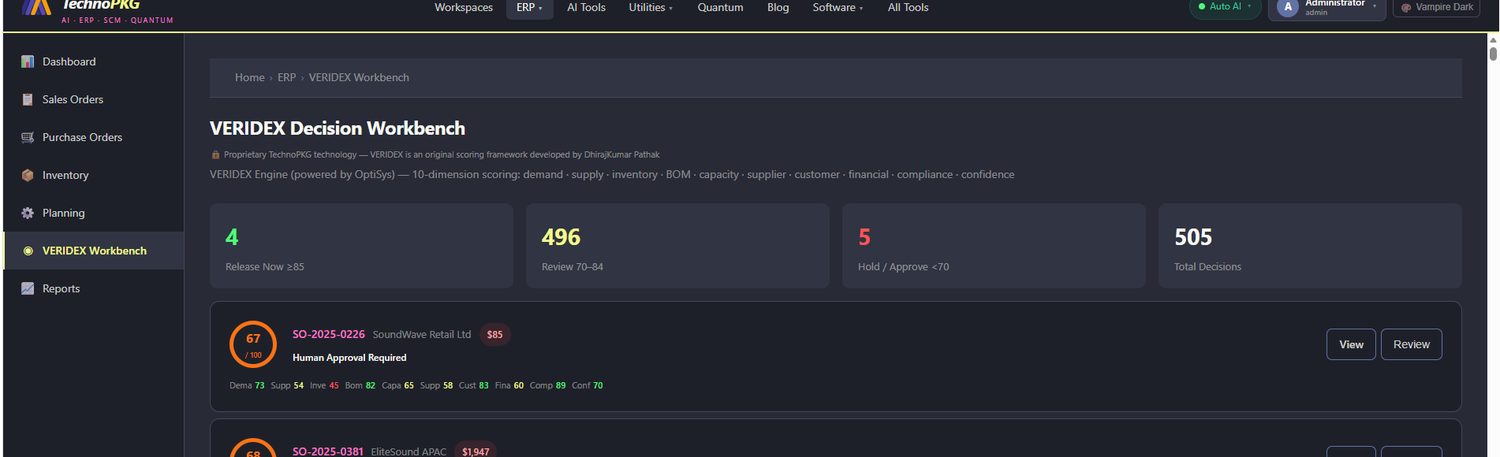
The page header states its pedigree: VERIDEX is an original scoring framework developed by DhirajKumar Pathak — proprietary TechnoPKG technology, with the engine scoring every sales order across ten dimensions: demand · supply · inventory · BOM · capacity · supplier · customer · financial · compliance · confidence.
Read that list against the series and it maps almost one-to-one: demand (Tutorial 1), supply and supplier (Tutorials 2 and 11), inventory (Tutorial 3), BOM (Tutorial 7), capacity (Tutorial 9), customer and financial (Tutorial 10's registries and margins). The workbench is the series' table of contents, compressed into a score.
Triage at Scale
The four counters across the top show what the engine is really for — sorting a volume of decisions no human could individually inspect:
- 4 orders at ≥85 — Release Now: clean on every dimension, no human needed
- 496 at 70–84 — Review: the broad middle, fine to proceed with eyes open
- 5 at <70 — Hold / Approve: something is genuinely wrong; a person must decide
- 505 total decisions scored
That shape is the point. Out of 505 orders, only five demand human judgment. The engine doesn't replace the planner — it spends the planner's attention where the risk actually is.
Anatomy of a Hold
The first card in the queue is SO-2025-0226 — SoundWave Retail Ltd, $85, scored 67/100: Human Approval Required. Under the headline, all ten dimensions show their sub-scores:
| Dimension | Score | Dimension | Score |
|---|---|---|---|
| Demand | 73 | Supplier | 58 |
| Supply | 54 | Customer | 83 |
| Inventory | 45 | Financial | 60 |
| BOM | 82 | Compliance | 89 |
| Capacity | 65 | Confidence | 70 |
(Average the ten and you get 67.9 — a whisker from the displayed 67, so the dimensions carry roughly equal weight.)
Reading the Score Like a Planner
The low sub-scores aren't mysterious — you've met every one of them earlier in this series:
Inventory 45, the weakest dimension: stock can't comfortably cover this order — recall the on-hand vs available gaps from Tutorials 3 and 7, where most of the cabinet and amplifier stock was already allocated.
Supply 54 and Supplier 58: the lead-times page (Tutorial 11) said it plainly — suppliers below 80% reliability reduce the VERIDEX score significantly and may trigger a Hold — and GlobalParts Warehouse sits at 79% reliability with 74% on-time delivery.
Capacity 65: the PCB Soldering Line is running at 119% this week (Tutorial 9). An engine that ignored that would be lying.
Meanwhile the strong dimensions are just as legible: Compliance 89, Customer 83 (SoundWave is an active corporate account — the same CUST-001 from Tutorial 10, and the same customer whose earlier order shipped in Tutorial 11), and BOM 82 (the structure from Tutorial 7 is complete and active). The order isn't bad — its fulfilment environment is strained, and the score says exactly where.
The next card in the queue makes the contrast: SO-2025-0381 — EliteSound APAC, $1,947, scoring 68 — a bigger order, same band, same conversation for a human to have. Each card carries View and Review buttons: the engine flags, the person decides. That's the design.
Try It Yourself
- Create a sales order from the New Sales Order form (Tutorial 1) and watch the button do what it promises: Create Sales Order + Calculate VERIDEX.
- Open any Hold-band order and find its weakest dimension — then visit the tutorial page that explains it (inventory → Tutorial 3, capacity → Tutorial 9, supplier → Tutorial 11).
- Average the ten sub-scores on any card and compare with the headline number.
- Ask the planner's question about SO-2025-0226: what single action would raise this score most — expediting stock, or rescheduling around the soldering line?
The Series, In One Sentence
Twelve tutorials ago this series started with a single sales order; it ends with an engine that scores every sales order against everything the other eleven tutorials built — demand, stock, structures, hours, and promises. If you can read a VERIDEX card and know why each number is what it is, you can read this ERP. That wraps the series — thanks for following along, and the portal's ERP sidebar is now yours to explore.
Comments (0)